Electricity
Self-Assessment
Card 1 of 12
Circuit Symbols
Standard symbols are used to draw circuit diagrams — students must recognise and draw them all.
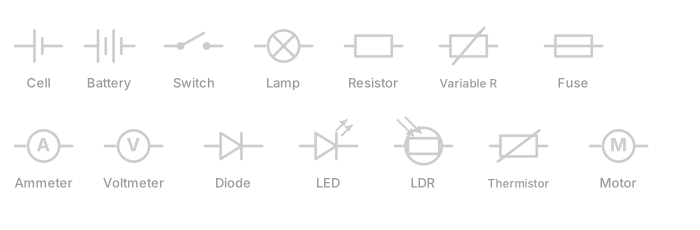
These come up on every circuits question. Ammeter in series, voltmeter in parallel — getting this wrong invalidates the whole circuit.
Circuit Symbols — Key Knowledge
Charge, Current and Potential Difference
Current is the flow of charge. Potential difference is the energy transferred per unit charge.
Q = It, V = W/Q
charge = current × time, voltage = work done ÷ charge
Current is not "used up" — the same current flows out of the battery as back in. Energy is transferred, not charge consumed.
Charge, Current and Potential Difference — Key Knowledge
- Current rate of flow of charge, measured in amps
- Charge measured in coulombs
- Potential difference energy per coulomb, measured in volts
Resistance and Ohm's Law
The most-used equation in electricity — links voltage, current, and resistance. Rearrange it for any of the three.
V = IR
voltage = current × resistance
V = IR underpins almost every electricity calculation. Rearrange: I = V/R, R = V/I.
Resistance and Ohm's Law — Key Knowledge
- Resistance opposition to current flow, measured in ohms Ω
- Ohm's law only holds when temperature is constant ohmic conductors
- Higher resistance means lower current for a given voltage
I-V Characteristics
Different components produce different current-voltage graphs, revealing how their resistance behaves.
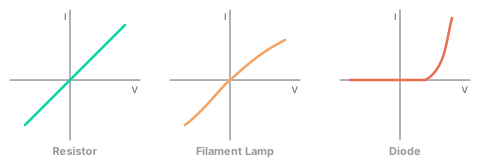
Must be able to sketch and interpret all three graphs. The resistor is ohmic; the lamp and diode are non-ohmic.
I-V Characteristics — Key Knowledge
- Resistor straight line through origin — constant resistance
- Filament lamp curve — resistance increases as it heats up
- Diode current flows in forward direction only
LDR and Thermistor
Two components whose resistance changes with environmental conditions.
Both are used in sensing circuits. More light → less resistance. More heat → less resistance. Both go down.
LDR and Thermistor — Key Knowledge
- LDR resistance decreases as light intensity increases
- Thermistor resistance decreases as temperature increases
Series and Parallel Circuits
Components can be connected in a single loop (series) or on separate branches (parallel).
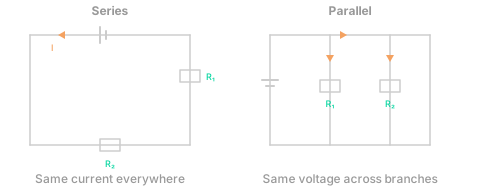
Adding components in series increases resistance. Adding a parallel branch decreases total resistance and increases total current.
Series and Parallel Circuits — Key Knowledge
- Series — current is the same everywhere; voltage is shared between components; total resistance = R₁ + R₂, Parallel — voltage is the same across each branch; current splits at junctions; total resistance is less than the smallest resistor
Electricity in the Home
UK mains is 230V ac at 50Hz, delivered through a three-wire plug with built-in safety devices.
The live wire is dangerous even when the switch is off. If a fault occurs, the earth wire carries a large current, blowing the fuse and breaking the circuit.
Electricity in the Home — Key Knowledge
- Live wire brown, 230V
- Neutral wire blue, ~0V
- Earth wire green/yellow, safety
- Fuse melts if current is too high, in the live wire
- Circuit breaker trips and can be reset
Electrical Power
Power is the rate of energy transfer. Energy transferred depends on power and time.
P = IV, P = I²R, E = Pt
P = I²R shows that doubling current quadruples power lost as heat — this is why high current is wasteful.
Electrical Power — Key Knowledge
- Power measured in watts
- Energy transferred measured in joules
The National Grid
The network of cables and transformers that delivers electricity from power stations to consumers.

P = IV: same power at higher voltage needs lower current. P = I²R: lower current means far less heating in the cables.
The National Grid — Key Knowledge
- Step-up transformer increases voltage for transmission
- Step-down transformer decreases voltage for homes
- High voltage means lower current means less energy wasted as heat in cables
Static Electricity*
Rubbing insulating materials together transfers electrons — one object becomes negative, the other positive.
No charge is created or destroyed — it is transferred. *Physics Only topic.
Static Electricity* — Key Knowledge
- Only electrons move protons stay fixed
- Like charges repel; unlike charges attract, Sparking occurs when charge builds up then discharges
Electric Fields*
A charged object creates an electric field around it. Other charges in that field experience a force.
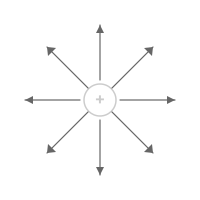
Explains non-contact forces between charged objects. *Physics Only topic.
Electric Fields* — Key Knowledge
- Electric field region where a charge experiences a force
- Field is strongest close to the object, Field lines point away from positive and towards negative
Required Practicals — Resistance and I-V
Two key practicals: investigating how wire length affects resistance, and measuring I-V characteristics of components.
Must be able to describe the method, draw the circuit diagram, and identify which variables are independent, dependent, and controlled.
Required Practicals — Resistance and I-V — Key Knowledge
- RP3 — vary wire length and measure R using ammeter and voltmeter (R = V/I); control temperature, material, and cross-section, RP4 — use a variable resistor to vary pd; plot I-V graphs for resistor, lamp, and diode
Session Complete
Electricity
0%confident
✔
0
0
❓
0
0
✖
0
0
Copy your result link and paste it into the WhatsApp revision group
Back to Topics